Why I Watch the 10-Year Treasury (And Why Real Estate Agents Should, Too)

I have a confession. I pay attention to the 10-year U.S. Treasury yield probably more than most people would consider normal.
Not because I’m secretly trying to become a Wall Street trader. And certainly not because I enjoy staring at bond-market charts.
I watch it because I work in real estate, and understanding what’s happening in the broader financial market helps me have better conversations with agents, buyers, and industry partners.
And frankly, I think more real estate professionals should be watching it.
First, what exactly is the 10-year Treasury?
Without getting too deep into Economics 101, the 10-year Treasury is essentially a way for the federal government to borrow money from investors for 10 years.
The yield reflects the return investors can expect based on the price they’re paying for that Treasury security.
Here’s why I care.
The 10-year Treasury is one of the most useful indicators for understanding where 30-year fixed mortgage rates may be headed.
They’re not directly connected by some magical formula, but they often move in the same direction.
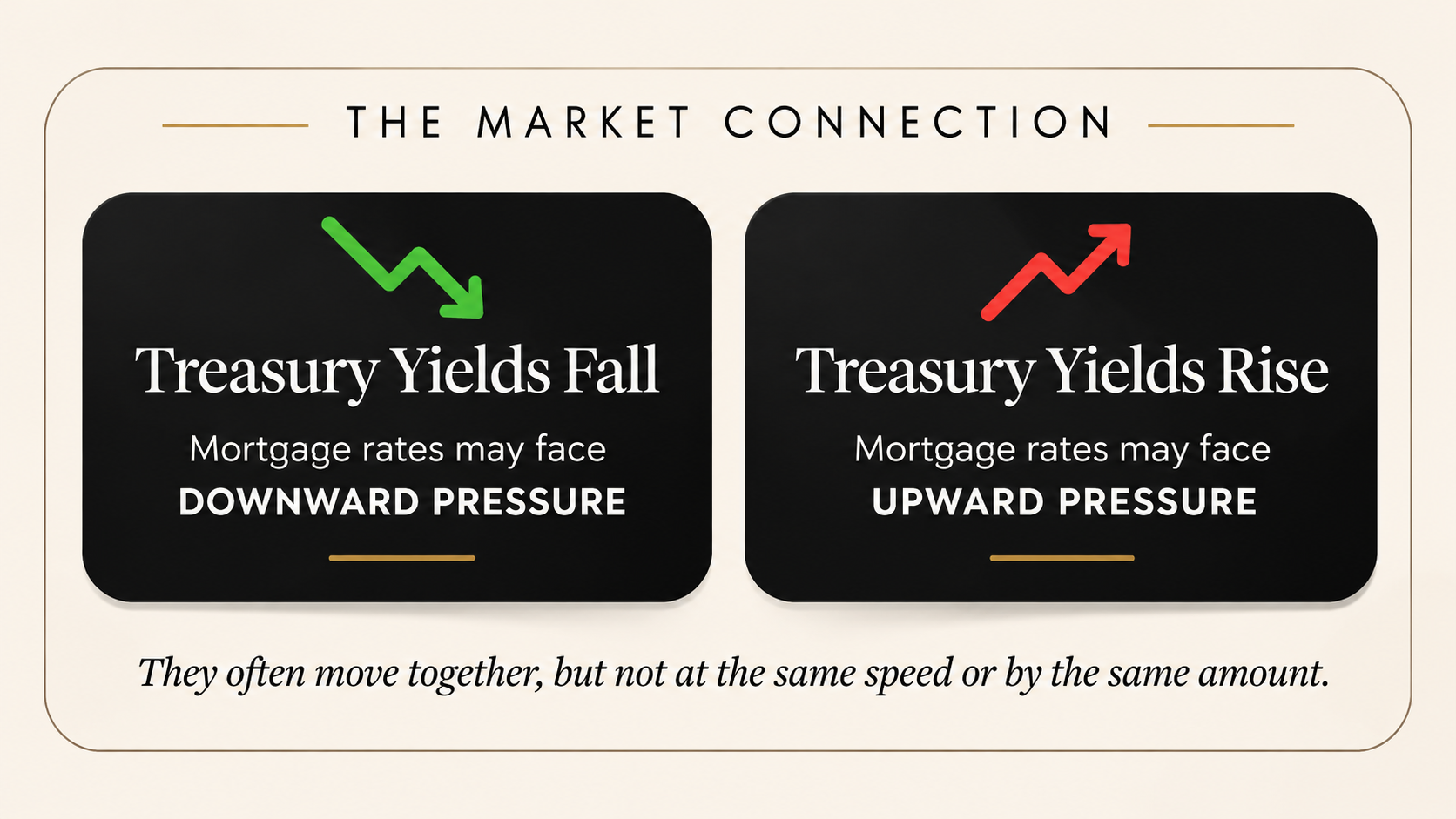
When Treasury yields rise, mortgage rates generally face upward pressure.
When Treasury yields fall, mortgage rates may have room to come down.
Notice I said may.
That’s important.
How I actually use it
I have an alert set up to monitor the 10-year Treasury yield throughout the day.
But I don’t need to know every time it moves a fraction of a percentage point. That’s just noise.
Instead, I focus on movements of 10 basis points or more compared with the previous market close.
For anyone unfamiliar with basis points, 10 basis points equals 0.10 percentage points.
So if the Treasury yield moves from 4.90% to 4.80%, that’s a 10-basis-point decline.
Does that automatically mean mortgage rates dropped by the same amount?
Absolutely not.
But it tells me something meaningful may be happening in the bond market, and that’s worth investigating.
When I see a significant movement, I start asking questions.
What’s driving it? Inflation data? Employment numbers? Investor expectations about the economy? Something the Federal Reserve said?
And, most importantly, what could this mean for the buyers and agents I’m working with?
That’s where the information becomes useful.
Stop waiting for the Fed to tell you what’s happening.
One of the biggest misconceptions I hear in real estate is that mortgage rates are simply waiting for the Federal Reserve to make its next move.
“The Fed is cutting rates, so mortgage rates should drop, right?”
Not necessarily.
The Fed primarily influences short-term interest rates. Mortgage rates, particularly 30-year fixed rates, respond to longer-term economic expectations and the mortgage-backed securities market.
That’s why the Fed can lower its benchmark rate while mortgage rates actually increase.
Confusing? A little.
But that’s exactly why I watch the Treasury market instead of relying exclusively on headlines about the Fed.
The bond market often starts adjusting to economic expectations before the Fed makes an announcement.
What does this mean for my conversations with agents?
I don’t believe real estate agents need to become economists.
But I do believe we have a responsibility to understand the factors influencing our clients’ decisions.
If an agent calls me and says, “My buyer wants to wait until rates come down,” I want to help them think beyond that one number.
Because here’s the reality.
Lower mortgage rates can improve affordability, but they can also bring more buyers into the market.
And depending on inventory, increased competition can put upward pressure on home prices.
So the buyer who waited six months for a better interest rate might find themselves competing against five other offers.
Or they might not. Every market is different.
That’s why I encourage agents to focus on the full picture: financing, monthly payments, available inventory, negotiating leverage, and the buyer’s long-term goals.
A lower rate doesn’t automatically mean a better deal. And a higher rate doesn’t automatically mean it’s the wrong time to buy.
Here’s what I want agents to take away.
You don’t need to check Treasury yields every morning.
I’ll happily be the person who does that.
But when you hear that the 10-year Treasury has dropped significantly, understand why it matters.
It’s an opportunity to connect with your lending partners, ask questions, and potentially revisit conversations with buyers who have been sitting on the sidelines.
Not to tell them rates have dropped when they haven’t.
Not to promise them a better mortgage.
But to have a more informed conversation about their options.
That’s what separates simply sharing market headlines from actually being a resource.
My final thought
Real estate is about more than houses, contracts, and closing dates.
It’s about understanding the forces that influence people’s ability and willingness to buy, sell, and invest.
The 10-year Treasury is just one piece of that puzzle, but it’s a piece I believe is worth understanding.
At SMART Settlements, I spend a lot of time working with agents, helping them grow their businesses and navigate an industry that’s constantly changing.
My goal isn’t to overwhelm anyone with financial terminology. It’s to take information that can feel complicated and make it practical.
Something you can keep in your back pocket and actually use in your next client conversation.
And if I can save you from having to read a 30-page economic report in the process, even better.
We don’t just close, we open doors.
Franklyn Salas
Director of Marketing & Sales | SMART Settlements
The information shared is for educational purposes only. Treasury yields are market indicators, not direct quotes or guarantees of mortgage-rate movements. Consult a licensed mortgage professional for current loan pricing and financing advice.